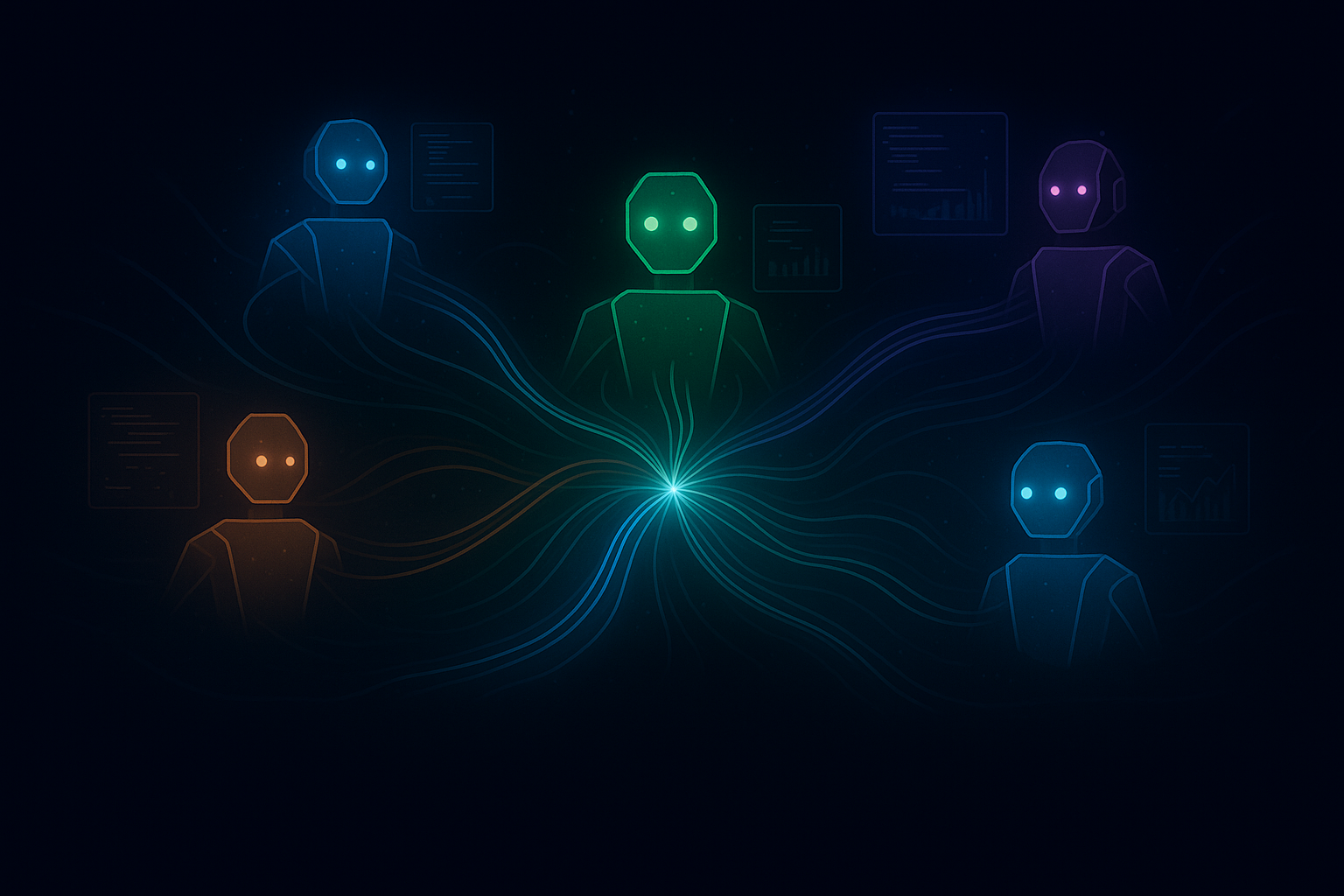
Imagine you’re managing a restaurant where instead of human staff, you have AI assistants. One handles reservations, another manages inventory, a third creates menus, and a fourth handles customer complaints. Now imagine these AI assistants can talk to each other, share information, remember past interactions, and coordinate their actions without you orchestrating every move. That’s essentially what Agentic AI is all about – and researchers from Tunisia just published a comprehensive analysis of how we’re building these systems today.
From Solo Players to Team Members
Traditional AI agents were like vending machines – they could only respond to specific inputs with predetermined outputs. Push button A, get snack B. Simple, predictable, limited. But modern Agentic AI, powered by Large Language Models (LLMs) like GPT-4, is more like having a team of smart interns who can think, reason, adapt, and most importantly, collaborate.
The researchers explain that these modern agents are “autonomous and collaborative entities” that can dynamically interpret contexts, use various tools, and adapt their behavior through memory and interaction. It’s the difference between a calculator (traditional AI) and a financial advisor who remembers your investment history, understands market contexts, and coordinates with tax experts (Agentic AI).
The Framework Zoo: Different Approaches to Building AI Teams
The paper reviews several major frameworks for building these intelligent agent systems. Think of these frameworks as different management philosophies for organizing your AI workforce:
CrewAI: The Role-Based Team
CrewAI is like running a newsroom where each AI has a specific role – researcher, writer, editor, or fact-checker. Each agent knows their job and can delegate tasks to others. The framework emphasizes coordination and delegation, making it perfect for projects that need specialized expertise working together.
AutoGen: The Conversation Facilitator
Microsoft’s AutoGen enables rich multi-agent conversations. It’s like having a conference room where AI agents can discuss, debate, and collaborate on solutions. One agent might write code, another reviews it, and a third tests it – all through structured dialogue.
LangGraph: The Workflow Orchestra
LangGraph uses a graph-based approach, treating tasks like a flowchart where work moves from one agent to another in a structured sequence. Imagine an assembly line where each station (agent) performs specific operations before passing the work along. This makes it excellent for traceable, scalable processes.
MetaGPT: The Software Company Simulator
MetaGPT literally simulates an entire software development team. You have AI agents playing project manager, architect, developer, and tester roles. It’s like having a miniature tech startup in a box, complete with role-specific behaviors and interactions.
Semantic Kernel: The Enterprise Orchestrator
Microsoft’s Semantic Kernel provides enterprise-grade orchestration with fine control over planning, memory, and skill execution. Think of it as the corporate management system for AI agents, with all the structure and control that implies.
The Language of Cooperation: How Agents Talk
One of the paper’s most fascinating sections discusses how these AI agents communicate. Just as humans need common languages and protocols to work together effectively, AI agents need standardized ways to exchange information.
The researchers examine several communication protocols:
- Model Context Protocol (MCP): Like a universal translator for AI-to-tool communication
- Agent-to-Agent Protocol (A2A): Google’s approach, enabling memory management and goal coordination between agents
- Agent Network Protocol (ANP): Uses decentralized identifiers, like giving each agent a unique ID card and communication rules
- Agora: A meta-protocol that helps agents choose which communication method to use – like a diplomatic protocol officer
The challenge? These protocols don’t always play nice together. It’s like having team members who speak different languages – CrewAI agents can’t directly understand AutoGen agents without translation layers.
Memory: The Secret to Smarter Agents
The paper reveals that memory is crucial for making agents truly intelligent. The researchers identify several types:
- Short-term memory: Like a notepad for current conversations
- Long-term memory: A filing cabinet of past interactions and learned preferences
- Semantic memory: Understanding concepts and relationships
- Episodic memory: Remembering specific past events in detail
- Procedural memory: Knowing how to perform specific tasks
Different frameworks handle memory differently. LangGraph preserves state within its workflow nodes, while CrewAI gives each agent individual memory for role-specific coordination. Some frameworks, like SmolAgents, keep it minimal, prioritizing simplicity over sophistication.
Safety Rails: Keeping AI Agents in Check
Just as you wouldn’t let interns access your company’s bank accounts unsupervised, these frameworks need “guardrails” to ensure AI agents behave safely. The researchers found that safety measures vary widely:
- AutoGen includes validators and retry logic
- LangGraph enables flow-level checks
- OpenAI SDK supports schema validation
- Some frameworks like SmolAgents have no guardrails at all, prioritizing developer control
This inconsistency is concerning – it’s like having some employees follow strict security protocols while others have no oversight whatsoever.
The Service Computing Challenge
The researchers ask a crucial question: Are these frameworks ready to integrate with existing business systems? The answer is mixed. Some frameworks like Semantic Kernel and Google ADK show promise for enterprise integration, but most lack the standardized interfaces that enterprise systems expect.
It’s like trying to plug modern smart home devices into a building’s old electrical system – technically possible, but requiring numerous adapters and workarounds.
Current Limitations: The Reality Check
The paper doesn’t sugarcoat the challenges:
Rigid Roles
Most frameworks lock agents into predefined roles. Once an agent is designated as a “coder,” it can’t easily switch to being a “reviewer” mid-task. This is like having employees who can never learn new skills or adapt to changing needs.
No Dynamic Discovery
Agents can’t spontaneously find and collaborate with new partners. All relationships must be predefined, limiting scalability and emergent cooperation. Imagine a networking event where people can only talk to pre-assigned partners.
Code Safety Risks
When agents generate and execute code (common in several frameworks), they pose security risks. Generated code might access file systems, run shell commands, or perform unsafe operations. The researchers recommend sandboxing and restricted execution environments.
Interoperability Gaps
Each framework operates in its own silo. A CrewAI task can’t be interpreted by an AutoGen agent without significant translation. This fragmentation prevents code reuse and seamless integration.
The Road Ahead
The researchers conclude that while Agentic AI frameworks have made remarkable progress, they’re still in their early stages. The field needs:
- Standardized communication protocols – a universal language for agent interaction
- Better safety mechanisms – consistent, robust guardrails across all frameworks
- Dynamic discovery capabilities – allowing agents to find and collaborate with new partners
- Improved interoperability – enabling different frameworks to work together seamlessly
Why This Matters
This research provides a crucial reality check on the state of AI agent technology. While the hype suggests AI agents are ready to revolutionize work, the reality is more nuanced. These systems show tremendous promise but face significant technical and architectural challenges.
For businesses considering Agentic AI, the message is clear: the technology is powerful but not yet mature. Early adopters should expect to invest in integration, safety measures, and potentially custom development to bridge current gaps.
The paper serves as both a comprehensive guide to current capabilities and a roadmap for what needs to be built. As these frameworks evolve and standardize, we’ll likely see AI agents become as common in workplaces as email and spreadsheets. But that future, while approaching rapidly, isn’t quite here yet.
The restaurant of AI assistants I described at the beginning? We’re still figuring out how to get them to reliably share orders between the kitchen and the dining room. But once we do, the possibilities are truly transformative.
Source: https://arxiv.org/abs/2508.10146