The Testing Revolution Nobody Saw Coming
It’s 3 AM, and while your QA team sleeps, an AI agent discovers a critical bug in your payment system, writes a comprehensive test suite to prevent similar issues, updates the documentation, and sends a detailed report to your inbox. By morning, it’s already tested the fix across 3,000 browser combinations and self-healed 47 broken test scripts that would have taken your team days to update.
This isn’t science fiction. It’s happening right now at companies like NVIDIA, Microsoft, and Google, where Agentic AI is transforming quality engineering from a bottleneck into a competitive advantage. And the numbers? They’re staggering: 85% reduction in test creation time, 90% reduction in maintenance effort, and 60% productivity gains across testing operations.
Welcome to the era where your testing team isn’t replaced by AI – it’s supercharged by it.
From Script Monkeys to Strategic Orchestrators
Let’s be honest about traditional test automation. You know the drill: spend weeks writing brittle scripts that break the moment someone changes a button color. Your QA team spends 30-50% of their time just maintaining these scripts, playing an endless game of whack-a-mole with false positives. One UI update, and suddenly hundreds of tests fail – not because there’s a bug, but because your XPath selector can’t find that login button anymore.
Enter Agentic AI. Unlike traditional automation that follows rigid rules, these AI agents think, reason, and adapt. When Tricentis launched their agentic test automation platform, early adopters didn’t just see improvements – they saw transformation. GE Healthcare watched their testing time plummet from 40 hours to just 4 hours. That’s not a typo. That’s a 90% reduction in testing effort.
Here’s what makes it different: Traditional automation is like a train on tracks – efficient but inflexible. Agentic AI is like a self-driving car with GPS, traffic awareness, and the ability to reroute on the fly. When your application changes, these agents don’t break; they adapt, learn, and keep testing.
The Multi-Agent Orchestra: How AI Teams Actually Work
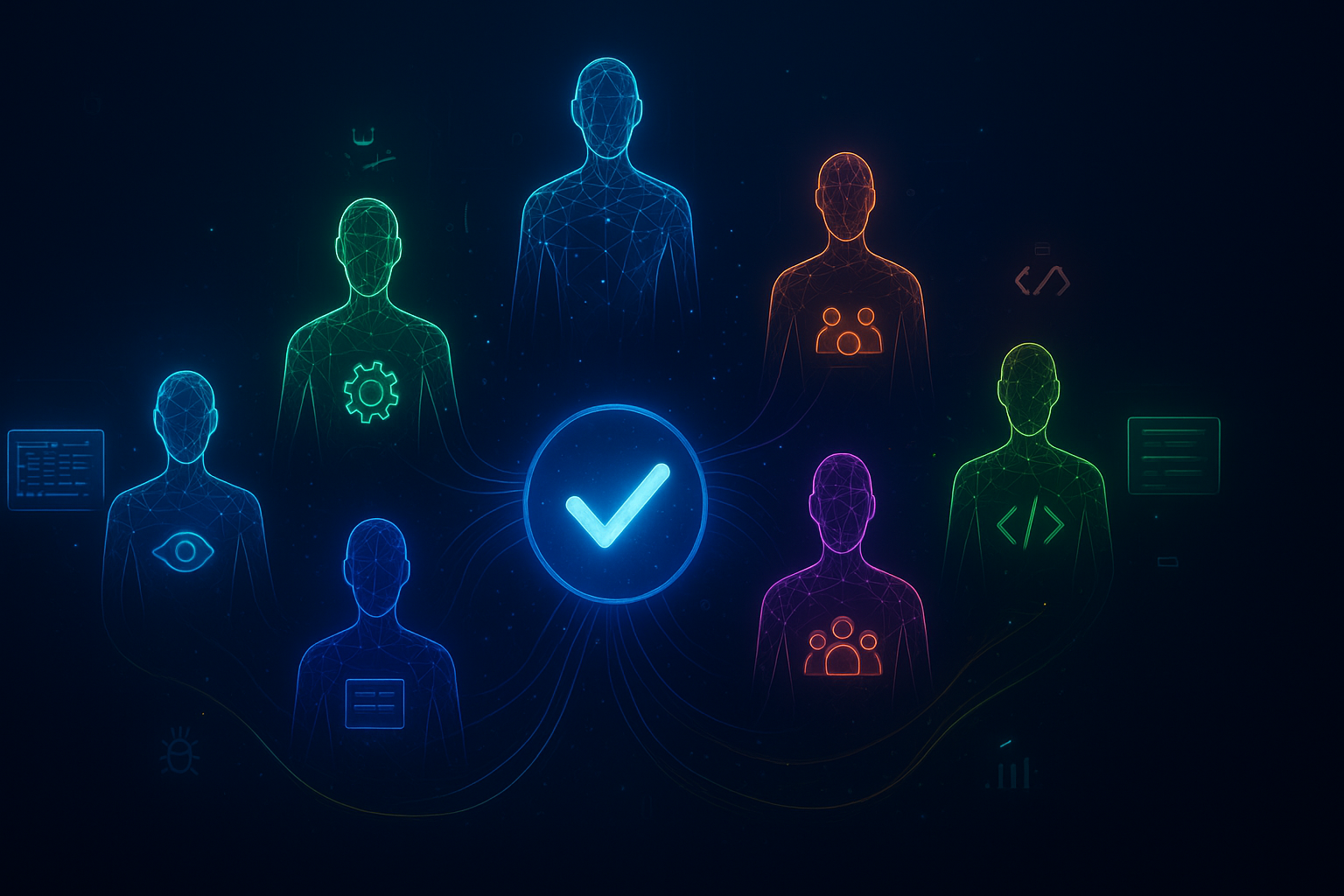
The real magic happens when multiple AI agents work together. Think of it like a jazz band where each musician knows their part but can also improvise and respond to others.
At NVIDIA, their Hephaestus framework deploys a team of specialized agents for automotive software testing. One agent reads requirements, another generates test cases, a third maps data dependencies, and a fourth executes tests. The result? 10 weeks of development time saved and 95% accuracy in requirement-to-test traceability. That’s like having a QA team that never sleeps, never gets tired, and never misses a detail.
Microsoft took a different approach with their Azure DevOps integration. They used GitHub Copilot to convert hundreds of manual test cases into automated Playwright scripts. The twist? Developers saw 30% productivity improvements because they could write tests in plain English instead of code. “Test that users can successfully reset their password” becomes actual, executable test code in seconds.
The architecture choices matter. Some companies use a “supervisor” model – one master agent coordinating specialist agents for UI, API, and performance testing. Others prefer “swarm” architectures where agents collaborate peer-to-peer, showing 50% better performance through direct communication. It’s like choosing between a traditional corporate hierarchy and a flat startup structure – each has its place.
The Platforms Leading the Charge
Tricentis emerged as the heavyweight champion, being first to market with true agentic capabilities. Their Vision AI doesn’t just run tests; it understands what it’s testing. Write “verify the shopping cart calculates tax correctly,” and it figures out how to test it across different states, currencies, and edge cases you didn’t even think of. Early adopters report 85% time savings in test creation.
Functionize took a different route with their “Digital Workers” – five specialized AI agents that work like a virtual QA team. Generate creates tests, Diagnose finds root causes, Maintain fixes broken tests, Document writes reports, and Execute runs everything. It’s like hiring five expert QA engineers who work 24/7 and never ask for vacation.
Open-source alternatives are catching up fast. LangGraph lets you build custom agent workflows using directed graphs (think flowcharts on steroids), while CrewAI provides role-based coordination perfect for teams wanting to experiment without enterprise pricing. Microsoft’s AutoGen enables conversation-based collaboration between agents – they literally talk to each other to solve testing problems.
The Money Talk: ROI That Makes CFOs Smile
Let’s talk numbers that matter to your bottom line. Companies typically invest €15,000-€120,000 annually in AI testing platforms. Sounds steep? Here’s the kicker: they’re seeing positive returns within 3-4 testing cycles.
A typical enterprise spending €500,000 annually on QA can save €260,000 per year through:
- €160,000 in reduced maintenance costs (80% less script fixing)
- €100,000 in revenue impact from 30-60% faster releases
- Prevented production bugs (which cost 30x more to fix than caught in testing)
Startups see almost immediate returns with 3-5 day setup versus 2-3 weeks for traditional approaches. The acceleration in testing cycles means features reach market faster, creating competitive advantages beyond just cost savings.
But it’s not all sunshine and rainbows. According to research, 49% of organizations struggle to demonstrate clear value from their AI projects due to unclear metrics and expectations. Gartner predicts 40% of agentic AI projects will fail by 2027 – not because the technology doesn’t work, but due to unclear business value definitions and inadequate risk controls. The lesson? Treat AI as a powerful tool requiring proper implementation, not a magic wand.
Real Companies, Real Results
Google’s Smart Test Selection shows what’s possible at web scale. Their AI analyzes historical failure data, code dependencies, and commit patterns to predict which tests to run. Result? 50% reduction in test execution time while maintaining quality. They’re essentially teaching their tests to be predictive rather than reactive.
In healthcare, University Hospital Antwerp achieved a 95% reduction in test maintenance effort for their electronic medical records system. Their secret? Visual AI that recognizes screen elements regardless of how they’re coded. The system literally “sees” the application like a human would, making it immune to code-level changes that break traditional scripts.
Financial services are seeing dramatic improvements too. HSBC reported 2-4x increase in suspicious activity detection with 60% fewer false alarms requiring manual review. Their AI agents learned patterns human analysts consistently missed, catching sophisticated fraud schemes that would have slipped through traditional rule-based systems.
The Road Ahead: What 2025-2030 Looks Like
The trajectory is clear and accelerating:
2025-2027: The Foundation Years
- 25% of companies will launch agentic AI pilots by 2025
- Self-healing tests become mainstream
- Multi-agent collaboration reaches enterprise maturity
- 50% deployment expected by 2027
2028-2030: The Transformation
- AI predicts bugs before code deployment
- Fully autonomous testing pipelines optimize based on business outcomes
- “Guardian Agents” monitor and contain other AI agents (Gartner’s prediction)
- 33% of enterprise applications will include agentic capabilities by 2028
- 15% of day-to-day work decisions made autonomously through agentic AI (up from 0% in 2024)
The market tells the story: Over $2 billion invested in agentic AI startups in two years, with projections reaching $10.41 billion by 2025 (56.1% CAGR). Patent applications for AI testing hit 237,786 globally. This isn’t a trend; it’s a fundamental shift in how software quality is assured.
Your Playbook for Success
Start small but think big. Here’s your practical roadmap:
- Pick your pilot wisely: Choose a high-impact, low-risk area. Login flows, checkout processes, or API testing are perfect starting points.
- Measure everything: Establish baseline metrics before implementing AI. You can’t improve what you don’t measure.
- Choose proven platforms: This isn’t the time for bleeding-edge experiments. Tricentis, Functionize, or Microsoft’s solutions have enterprise track records.
- Invest in your people: Your QA team needs to evolve from script writers to AI orchestrators. Budget €5,000-€20,000 annually for training to address the skills gap.
- Plan for governance: By 2028, Gartner predicts you’ll need “Guardian Agents” to monitor your AI agents. Start building that framework now.
- Set clear value metrics: With 49% of organizations struggling to demonstrate AI project value, define success criteria upfront – whether it’s reduced testing time, increased coverage, or faster release cycles.
The Bottom Line
Agentic AI in quality engineering isn’t coming – it’s here. Companies using it are shipping better software faster while spending less on testing. Those ignoring it are accumulating technical debt that will eventually bury them.
The data is clear: 85% reduction in test creation time, 90% less maintenance effort, and 30-60% faster release cycles aren’t incremental improvements – they’re transformative changes that redefine competitive advantage in software development.
The question isn’t whether to adopt agentic AI for testing, but how quickly you can start. Because while you’re reading this, your competitors’ AI agents are already finding bugs, writing tests, and shipping features.
The future of quality engineering isn’t about humans versus machines. It’s about humans with machines, creating software quality that neither could achieve alone. And that future? It started about five minutes ago.
Welcome to the age of truly intelligent testing. The revolution is real, the results are proven, and the opportunity is now.